Continuing on with some more sport economics, this article explains the prices paid by the public when a team stadium is introduced and subsidized by the city. I found it very interesting that so many stadiums have been built in the last 20 years. On average, over half of the teams in the MLB, NFL, and NBA have received new stadiums. The argument is about whether these stadiums should be subsidized by the public, for private gains. Some economists argue that it hurts the local economy by lowering personal income. Others say that it is increasing the worth of the city and providing positive economic leisure benefits. I agree that stadiums are an important part of a local economy. Everyone here in Utah knows what the Delta Center is even if they don’t follow sports at all. The problem with subsidies is if a team happens to relocate and the public is left with the tab. This article about the Astrodome provides more information on the downside of stadium subsidies.
This blog contains posts and comments written by students in Dr. Tufte's economics classes at Southern Utah University.
4/13/2010
More Sports Economics... How Much are You Willing to Pay?
4/12/2010
Whose fault is it anyway?
Houston: We Have a Problem
4/11/2010
The Oil-pocalypse
Statistics for Dummies
4/07/2010
Exporting, We Hope
4/05/2010
There Ain't No Such Thing as a Free Laborer?
3/31/2010
Only costing more jobs?
Climate Deal Postponed
Why everyone wont have health insurance
Health... Auto... What's Next?
Will the market rally?
In January of 2009, the Federal Reserve started buying mortgage-backed securities that would total $1.25 trillion by the time the program ended at the end of the first quarter of 2009. According to an article in The Wall Street Journal, this program led many investors to buy corporate bonds. The author attributes the “rebound in the stock market” to the bond boom that came as a result of the buyback program.
With the buyback program ending today, some people are questioning whether or not the market is actually as strong as it seems. One portfolio manager, Joe Ramos, points out: “If we have an anemic recovery, then most of the market is overrated.” Jim Sarni, another portfolio manager, however disagrees, saying that the demand for high-yield bonds will sustain itself and the market will continue to rally.
Personally, I think that the bond buying will continue for at least a short period, but I think it will stop sooner than bullish investors like Sarni think it will.
Is Barack Keynesian?
3/30/2010
Health-Care Fix
States' Debt looking like Greek Debt
BRIC's are Building
3/29/2010
Economics in One Lesson
For another class, I read this summary of Henry Hazlitt's book, Economics in One Lesson. Thought written more than 60 years ago, his ideas have become more relevant with each passing decade, especially in the context of government spending during the past ten years or so. Even the summary is a bit lengthy, so you'll probably want to just skim it but here are two excerpts:
“It is highly improbable that the projects thought up by the bureaucrats will provide the same net addition to wealth and welfare, per dollar expended, as would have been provided by the taxpayers themselves, if they had been individually permitted to buy or have made what they themselves wanted, instead of being forced to surrender part of their earnings to the state.” (p. 36) "When the government makes loans or subsidies to business, what it does is to tax successful private business in order to support unsuccessful private business.” (pp. 47-8)
When government forcibly redistributes wealth from the rich to the poor, the increased costs that inevitably result cause a reduction in real wages.
Why we should hope the states win their lawsuits.
Who is ObamaCare Supporting?
The Wall Street Journal had an article titled “The ObamaCare Writedowns” that focuses on the effects the new healthcare plan will have on business. One of the major selling points of the new healthcare plan was that it will cut healthcare related costs over the next decade. However, it's already having immediate problems in the business world. Businesses like AT&T are making significant writedowns (estimated $1 billion) to compensate for the health bill. Everyone will have health insurance, but at what cost to business? Is it wise to pass something that may help the individual save on health costs or help those who are supporting the individual by giving them a job and monthly paycheck? This new plan neither supports the individual nor the company which leaves one question; who is ObamaCare supporting?
3/28/2010
Square pegs & Round holes
One big selling point of healthcare reform is that it will save money over time. I have a hard time believing that the goverment could correctly define "savings" at this point. I have yet to meet someone who believes that making private firms accept everyone as insured and then using goverment money which is generated through taxation to pay the difference of what they can afford and the newly generated cost will save money.
This has all the signs of Socialism written on it and in an economy that is down more taxation and imposed regulation will only slow the process of employment recovery and growth.
3/25/2010
Should we follow Canada's example in banking?
3/24/2010
New Deal - A Good Idea?
3/17/2010
Industry Instability through Subsidies
This is a good example of government subsidies moving an industry out of equilibrium. If the government subsidies had equaled the environmental costs of coal power generation as perceived by the Spanish public, then the value of the externalities would still be paid through private means in a typical Coasean scenario making the “green” option viable with or without government help. The problem of the government subsidies is the governments have a hard time judging the true cost of an externality thus they often over of under subsidize or over subsidize projects that could be taken care of in the market.
3/15/2010
Runaway
Has the Stimulus Bill Earned its Title?
3/14/2010
A Home: An Investment
I have been at SUU for close to four years now and, I have never heard one of my economics or finance professors say that buying a home is not a good investment. I ran some numbers to justify my point of view and this is what I found. My roommate and I pay $700 a month for renting a house in Cedar City, UT. We would pay this amount (700*12 months * 50 years) = 420,000 over our life time. Comparing this to if we were to borrow a $300,000 loan at 6 percent equals $367,680. There is a huge difference here, I can buy a home for $367,680 over 30 yrs and save $52,320 over 20 yrs not paying rent. I’m not counting the increase in value my home will gain over 30 yrs or the money I will be saving not making a mortgage payment over the next 20 yrs. What if I wanted to move and sell my house? Yes, the housing market could be in a slump and I might not recoup all the money I borrowed from the bank. So I lost some money but I also lose for paying rent for fifteen years and I decide to move. When housing prices rise rental fees rise, they do not remain the same. My conclusion it is always a good investment to buy a home when you are planning on staying somewhere for a long time.
An Austrian View on Health Care
1) This article notes that the state of US politics is not in an unusual position considering that we have changed into a large democratic regulatory-welfare state.
2) Secondly, the US is functioning as a large democratic regulatory-welfare state ought to.
3) Thirdly, because this article came from an Austrian School website, it also discusses the inherent inefficiencies of a command economy as would be the case with the bureaucratically run health care system as planed by the left.
Why Do People Trust Officials More Than Businesses?
3/10/2010
Graphing Obama's Budget
3/09/2010
Changes in the Fed
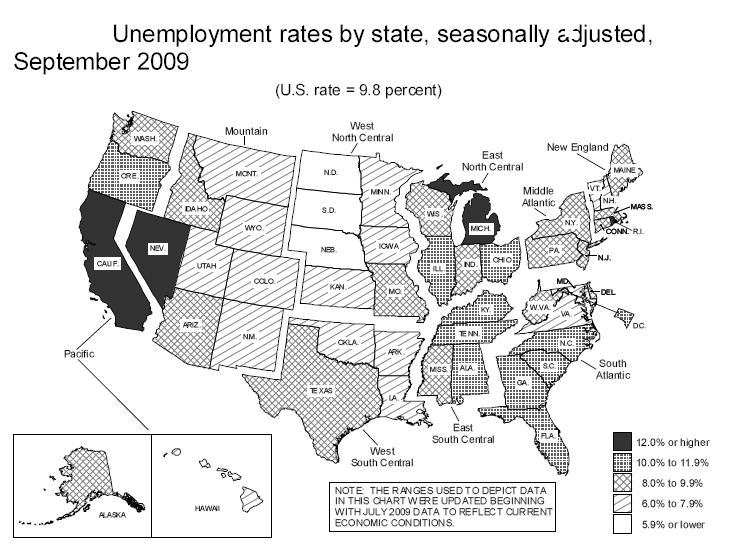
Unemployment Rate Graph
3/05/2010
Pride? What is it good for?
2/28/2010
Another Butterfly Effect?
How to fix California's Economy
1. Limit the growth of expenditures. He suggests, "Population growth plus inflation."
2. Put in some tax reforms that prevent the ups and downs in revenues to be so great.
3. Education, K12 is slipping. He mentions a setting up a program to encourage more teachers and their accountability.
According to the BEA California's economy in 2008 was 1,846 million (current dollars). It also reports the U.S.'s at 14,165 million. This makes California's economy 13.03% in 2008. I feel that if Califonia was able to limit the effects of a recession then that in turn would limit the overall affect on national GDP.
Mankiw's Take on Healthcare Reform
We have seen this type of bill before and not just from the Democrats. After all, as Dr. Tufte has pointed out on several times in class, Nixon introduced a bill with many of the same objectives. Mankiw points these similarities in his blog.
2/27/2010
More GDP and Earthquakes
In the wake of Haiti’s devastating earthquake, another South American country, Chile, has been rattled by a huge quake. Registering at 8.8 on the Richter scale, the earthquake was 1,000 times larger than Haiti’s. Comparing other factors, the epicenter of Haiti’s earthquake was 16 miles outside of Port-au-Prince, the country’s capital with a population of roughly 700,000. In Chile, the earthquake was centered 70 miles away from Concepcion, home to 900,000 people.
The striking difference is in GDP and the death toll. In the immediate aftermath, Chile has estimated 78 dead, with that number expected to rise. By how much it will rise, though, is the question. Haiti initially estimated more than 100,000 dead, clearly outdistancing initial Chilean reports. As discussed in class, GDP can be a good estimator of well-being. Chile’s per capita GDP is $14,700, more than 10 times the $1,300 of an average Haitian. By simply looking at GDP, the death toll should be far less than the 230,000 recorded in Haiti.
2/25/2010
Greek Credit Default Swaps
2/20/2010
Stat Planet
As we have talked about in class I used the HDI setting and compared the U.S. to Haiti. The U.S. came out at a .96 and Haiti at .53 where the larger number means you're better off. I tried to compare the Dominican Republic with Haiti but this has classified Dominican Republic as part of the U.S.
2/19/2010
How much Ammo will we give the Enemie?
As a country they have volitile leadership, are largely populated and supposedly are growing at a healthy rate. Now, with the amount of U.S. Treasury debt China holds, it feels to me we have allowed them the leverage to influence our economy as well? How many more aspects of power can we allow them to have before they realize it and begin to abuse it? I'm not a nay sayer but it seems to me that at the moment we as a country are in a bit of a hole and the first thing to do is stop digging and begin paying off our debts.
2/17/2010
Creating New Jobs
Nowadays, finding a job has turned into an almost “Impossible Mission”. Due to the recession, more and more people are losing their jobs every day. As we all know, the economy works like a production line. In a production line, if the first step of the process fails, the product probably won’t be completed. The same thing happens with the economy. If the economy starts falling down it results in a domino effect, consumers spend less money and in return the economy suffers the consequences.
This article talks about how some states in America are trying to solve one of the major problems in the construction of a healthy economy: Unemployment. States, such as Mississippi and Florida, are working on what they call “The steps program”. This program uses, like the article says- “A sliver of the $5 billion in welfare money in last year’s stimulus act”- in order to create employment in the private sector.
In my opinion this is an awesome theory. It would help the business to grow and in return help people to find jobs, which will improve their buying power and help the economy to rise again. In a sense this is the same production line that caused the downfall of the economy, however in reverse.
I have two questions about this theory however;
The businesses will receive benefits for hiring new workers. But once this money has stopped coming in, will the businesses keep those workers in employment?
Will this scheme be financially viable for small businesses to increase their profits enough with the new workers so that they can keep those workers on once the benefits expire?
Click here to read the article:
Unemployment rates by state, seasonally adjusted, September 2009